Leo Sivakumar shines in a high-stakes action thriller where a delivery boy’s moral choice spirals into a war against a brutal gang — but the film’s formulaic beats and loose logic keep it from breaking through.
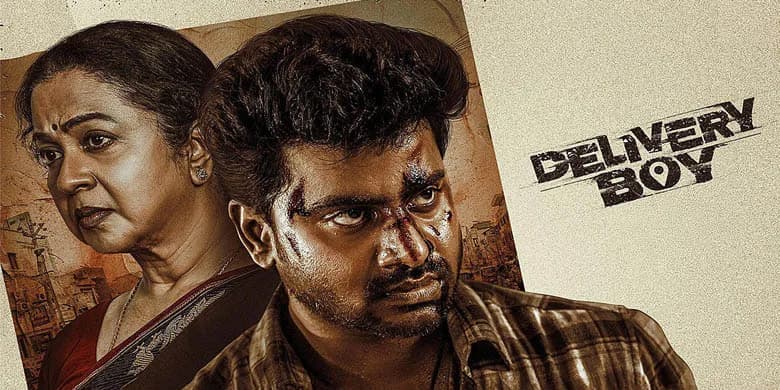
The first half of Delivery Boy feels like a slow burn wrapped in Tamil cinema’s most predictable package: the struggling son, the sick mother, the quiet dreamer with a heart of gold. Leo Sivakumar plays Siva, a delivery executive doubling as an aspiring cop, whose life cracks open when his mother’s health collapses.
Two lakh rupees — not much by industry standards, but everything to him, vanish from Dushyanth Jayaprakash’s wallet. Not out of greed. Out of desperation. And that single act sets off a chain reaction no one sees coming.
Not even Siva. Not even the audience. Not really. Because this is a story built on tropes, and it knows it.
It leans into them. It wears them like a second skin. So when Siva returns the money, only to find Dushyanth now hunted by a gang called the Bottle Gang, the shift isn’t shocking. It’s expected.
It’s required. And that’s the rub. The film doesn’t trick you. It asks you to believe anyway.
And for a while, it does. Leo Sivakumar, who’s been quietly building momentum, finally steps into the spotlight. He’s better here than he’s ever been, more grounded, more present. His fight scenes aren’t just choreography.
They’re consequences. When he stumbles, you feel it. When he stands, you want him to stay upright. Radhika Sarathkumar holds her end with quiet dignity, while Dushyanth Jayaprakash brings a rare vulnerability to a role that could’ve been reduced to a plot device.
The real standouts? The Bottle Gang. Seven men. No names.
Just menace. They move like shadows, speak in whispers, and leave behind bodies like footnotes. Their presence is felt long after their screen time ends. The technical work is sharp, Ashok Kumar Raj’s cinematography captures both the grit of city streets and the soft glow of domestic moments.
Sundaramurthy KS’ music hits the right notes, especially during the chase sequences. Vasanthakumar’s editing keeps the pace tight, though some transitions feel rushed. Nani, directing his first film, shows promise. He builds tension well.
He trusts silence. He knows how to frame a moment. But he also relies too heavily on the same old tricks: the sudden betrayal, the last-minute revelation, the hero’s redemption through sacrifice. These aren’t flaws.
They’re expectations. And when the film tries to subvert them, like when Siva chooses to protect Dushyanth despite knowing he stole from him, it lands because we’ve already bought into the emotional core. That’s the film’s strength. Its weakness?
The logic gaps. Why does the gang target Dushyanth? How did Siva get involved in the first place? Why does the police force seem so blind?
Answers are either vague or absent. The script doesn’t care about consistency. It cares about momentum. And momentum wins.
The climax is messy, loud, and satisfying. It’s not elegant. It’s not clever. But it works.
In the end, Delivery Boy isn’t a masterpiece. It’s not even groundbreaking. But it’s a solid commercial entertainer, the kind that fills theatres on weekends, gets discussed over chai, and leaves people saying, ‘Not bad.’ Leo Sivakumar has arrived. The Bottle Gang might be forgotten.
But the feeling? That stays. And that’s enough.




Be the first to comment
Join the argument. No password, just your email or a passkey.