Draft rules on land use and road widths do little to address decades-old parking and infrastructure strain in one of Bhopal's oldest residential pockets, experts say.
Bhopal's draft Development Plan 2047 is meant to be a reset button for the city. New rules on road widths, land use, building norms. But walk into Arera Colony and ask anyone who's lived there twenty years, and they'll tell you the plan barely touches what actually bothers them.
Parking. Water pressure. Sewage lines that back up when one more building goes up next door. These are old complaints in Arera Colony, and the draft plan, according to residents and urban planners quoted by the Free Press Journal, doesn't really answer them.
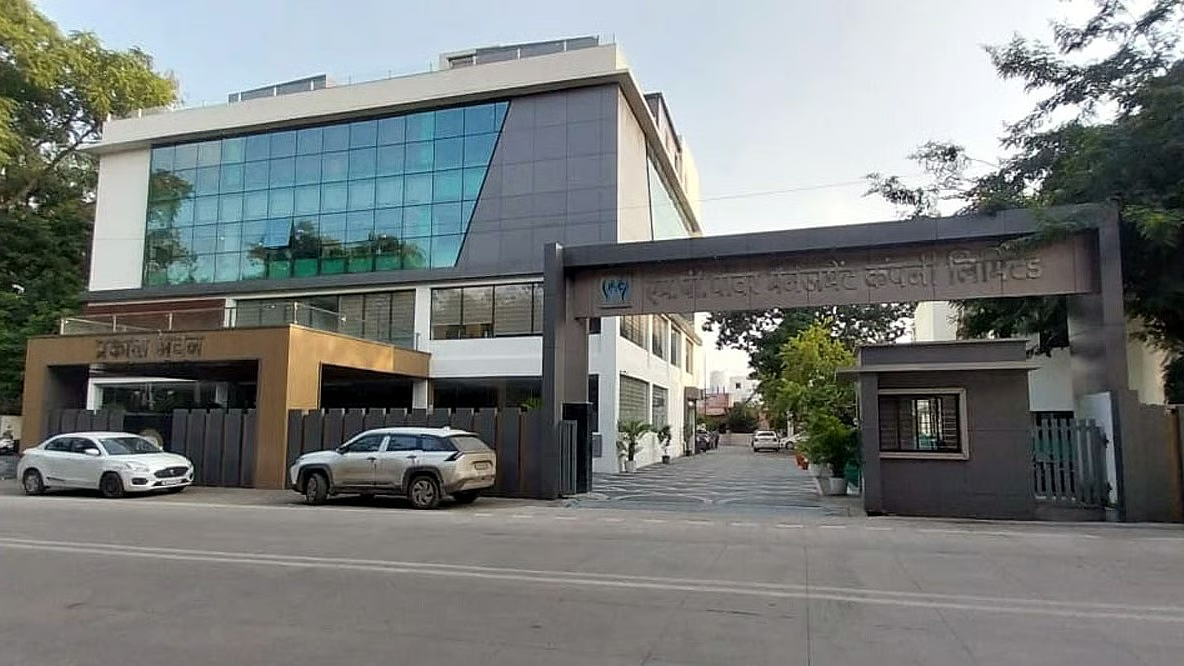
Purnendu Shukla, who lives in the colony, says the draft leans harder into commercialisation than it does into protecting what residential neighbourhoods actually need to function. His specific gripe is instructive. A chunk of Arera Colony is government-leased property, originally handed out to MPEB employees for housing. Today, several of those quarters run as offices instead. No engineer lives there. No MPEB staffer either, in many cases. Just desks and staff and, increasingly, large vehicles parked where a family car used to fit.
That's not a small detail. Large vehicles parked on residential lanes designed decades ago have already damaged sewage lines and residents' gates, Shukla says. And if the master plan's mixed-land-use provisions let this kind of activity continue under a residential lease, that's a problem baked into the document itself, not just an enforcement gap.
Here's the thing about the parking numbers in the draft. They look thorough on paper, multi-level facilities planned for MP Nagar Zone-1, Bairagarh, New Market, Ibrahimpura, Moti Masjid, plus a long list of on-street and off-street locations across the study area. What's missing is any separate inventory for Arera Colony itself. So the scale of the parking crisis you can read off this document tells you about Bhopal broadly. It tells you nothing about whether Arera Colony specifically gets relief.
Dr Krishna Kumar Dhote, who heads the Department of Architecture and Planning at MANIT, has flagged this directly. Leased properties, limited plot sizes, no fresh parking capacity, that combination doesn't resolve itself just because a city-wide plan gets approved. His bigger point is about sequencing. Before any more development gets waved through in the colony, someone needs to actually check whether water supply, drainage and electricity infrastructure can take the load. Right now, nobody's done that math for Arera Colony specifically.
Then there's the leasehold question, which the draft plan leaves conspicuously alone. Even if land use in these leased properties gets regularised after the fact, that doesn't convert the lease into freehold ownership. That conversion needs a Supreme Court direction, and the master plan says nothing about pursuing one.
So the document that's supposed to carry Bhopal to 2047 arrives with a gap right at its centre for one of the city's oldest colonies. Wider roads elsewhere, unresolved lease disputes and unmeasured parking demand at home. Whether the final version, once public feedback comes in, actually closes that gap is the question Arera Colony residents are now waiting on.


Be the first to comment
Join the argument. No password, just your email or a passkey.