The film asks a vital question — can you forgive someone who violated you? But it never lets the audience grapple with the answer. Instead, it forces one. And that’s the real failure.
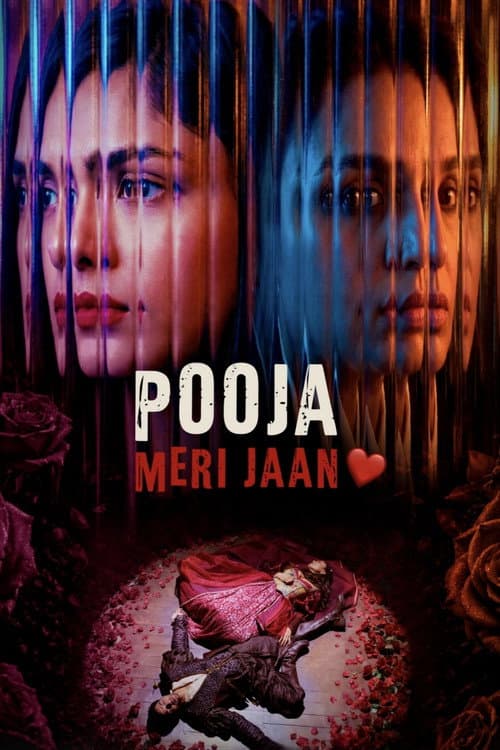
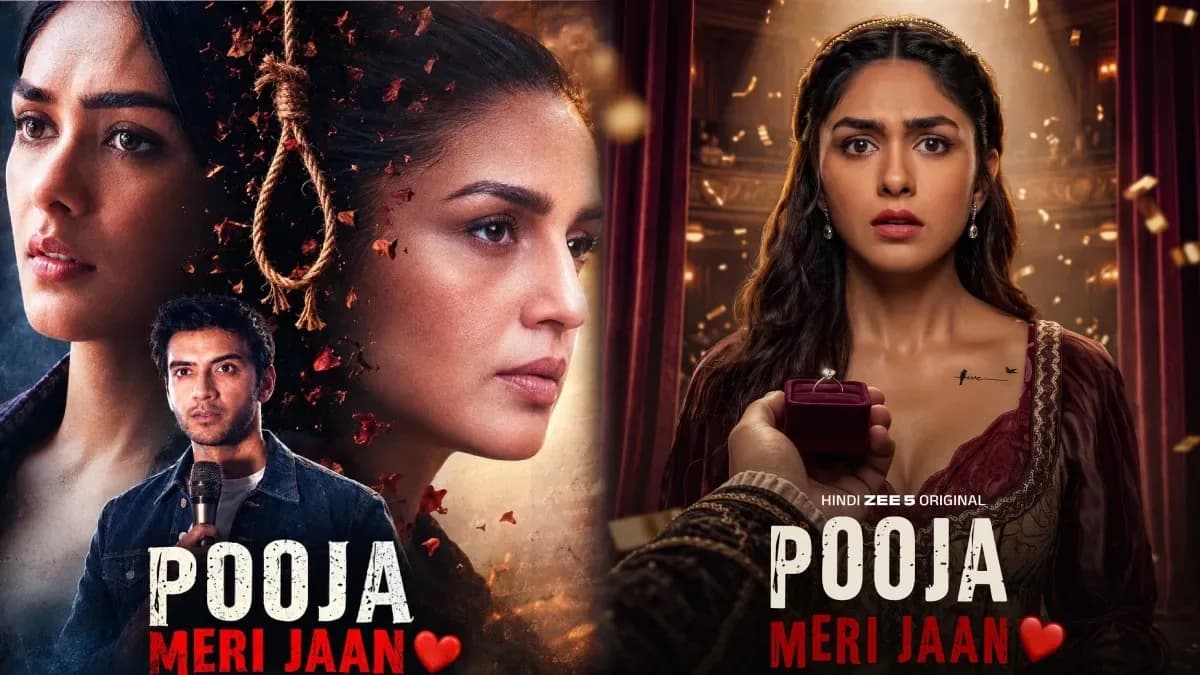
Pooja Meri Jaan opens with a ring on a hand, a proposal that isn’t accepted, and a man who dies in silence. By the time the credits roll, the film has spent two hours asking if consent can be negotiated after the fact — but it never answers. The question lingers, not because of clarity, but because the script keeps changing its mind.
One moment, it’s a courtroom drama about societal judgment. The next, it’s a thriller where the dead man becomes a monster. Then it pivots to a feminist manifesto, only to collapse under the weight of its own contradictions. The result?
A film that wants to be profound but ends up confused. And that confusion is the real crime here. Not the plot. Not the performances.
The failure to decide what kind of story it even wants to tell. Mrunal Thakur carries it, she’s committed, she’s present, but her Pooja feels like a cipher. Cold. Unreachable.
Even when the film tries to make her sympathetic, the character remains emotionally inert. Huma Qureshi, as her lawyer-friend Sana, is equally adrift. Her role makes no sense: why would a corporate lawyer take on a case this personal? Why does she fight so hard for someone she barely knows?
The film doesn’t explain. It just assumes. Vijay Raaz, as Aniket’s lawyer, gets one of the few moments of depth. He’s the first to accuse Pooja, the first to call her out.
But then he’s reduced to a silent observer in his own client’s trial. Vikram Singh Chauhan’s Aniket starts off as a romantic idealist, ek tarfa pyaar. But by the end, he’s a villain without nuance. The film never lets him be complex.
He’s either a victim or a predator. There’s no middle ground. That’s the problem. Consent isn’t a binary.
Rejection isn’t always clear-cut. But Pooja Meri Jaan treats both like checkboxes. It wants to say something about how women are judged for their pasts, for their choices, for their relationships. But instead, it blames men, loudly, unapologetically, and without consequence.
The final courtroom scene is supposed to be cathartic. Instead, it’s hollow. The judge delivers a verdict, the audience is meant to feel justice served. But the film has already failed.
It didn’t build the argument. It didn’t earn the emotion. It just declared it. Navjot Gulati and Vipasha Anand have good intentions.
They’ve picked a subject that matters. Rejection, obsession, the way society weaponizes a woman’s history. But they don’t trust the audience to think. They want us to hate Aniket, to pity Pooja, to believe everything at face value.
That’s not storytelling. That’s manipulation. The film’s biggest flaw isn’t its casting, its pacing, or its music. It’s its refusal to sit with ambiguity.
To let the audience wrestle with the question: Could you ever be friends with someone who tried to hurt you? The answer should be messy. Complicated. Human. But Pooja Meri Jaan gives us a simple yes, and then walks away.
So the real takeaway isn’t about the film. It’s about what we’re willing to accept from cinema now. A message wrapped in a mess. A cause dressed in chaos.
And still, people will watch. Because the question was worth asking. Even if the film couldn’t answer it.






Be the first to comment
Join the argument. No password, just your email or a passkey.