India is turning to Qatar for more than just gas. As part of a broader energy strategy, New Delhi is actively seeking Qatari investment to expand its refining capacity from 5.4 million barrels per day (bpd) to over 6.2 million bpd — driven by rising domestic fuel demand and the need to reduce import dependency. While Saudi Arabia and the UAE have long been central to India’s energy outreach, officials are now broadening engagement with Qatar, according to reports in the Gulf Times and state-run Qatar News Agency. The shift comes after high-level talks in April between India’s Minister of Petroleum and Natural Gas Hardeep Singh Puri and Qatar’s Minister of State for Energy Affairs Saad Sherida al-Kaabi, who also serves as President and CEO of QatarEnergy. During their two-day visit to Doha, both sides reaffirmed bilateral cooperation on energy, trade, and maritime supply chain security, stressing the importance of stable global fuel supplies amid regional disruptions. Long-term LNG agreements remain foundational: Petronet LNG extended its 20-year contract with QatarEnergy in 2024 to secure 7.5 million tonnes of annual imports through July 2028 and beyond. But the conversation has evolved. Now, discussions focus on mutual equity participation in processing assets across the energy value chain. Finance Minister Nirmala Sitharaman advanced this agenda during her meeting with Qatar’s Ali bin Ahmed Al Kuwari at the AIIB 2026 annual meeting in Doha on September 29. There, they discussed implementation of a $10 billion Qatari investment commitment, finalisation of a Bilateral Investment Treaty, and deeper financial integration, including expanding Indian UPI payments into Qatar and engaging the National Infrastructure and Investment Fund of India. They also addressed the Double Taxation Avoidance Agreement as a framework to enhance investment certainty. Sitharaman praised the arrangements for the AIIB summit and recalled recent leadership engagements that elevated India-Qatar relations to a strategic partnership. Al Kuwari acknowledged the Indian community’s role in Qatar’s development and expressed optimism about future collaboration in trade, finance, and investment. The momentum suggests India’s energy diplomacy is no longer limited to commodity deals. It’s moving toward joint infrastructure ventures. If the treaty and investment plans progress, the next phase of India’s refining expansion could carry a Qatari imprint.
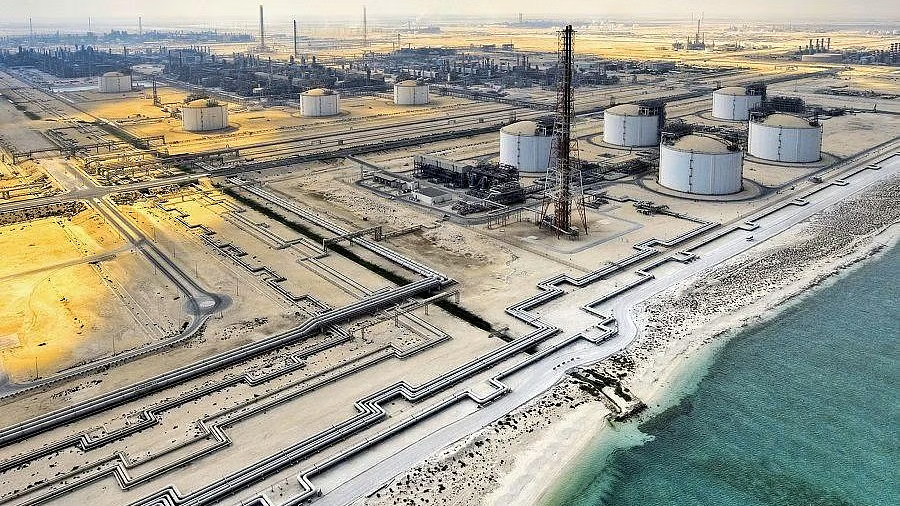 Photo via The Free Press Journal
Qatar’s $10B Energy Push: India’s Refining Expansion Gets a Gulf Boost
Qatar’s $10B promise isn’t just about gas—it’s about refineries, equity, and a new phase in India’s energy diplomacy.
Live site hype
around 3 reading right now · 44 today
Reported from
This article was written by the CutMirchi desk from the reporting above. Facts are attributed to their original publishers.
Read next

Doraemon: Castle Of The Undersea Devil Becomes 4th Highest-Grossing Anime Film In India
Doraemon: Castle Of The Undersea Devil has crossed 7.1 crore net at the Indian box office in just three days, becoming the fourth highest-grossing anime film in the country. With strong word-of-mouth and a loyal fanbase, it’s now on track to surpass Suzume and Shinchan: Our Dinosaur Diary.

Doraemon’s Undersea Run Could Break Franchise Records in India
Doraemon’s undersea adventure is pulling in ₹2.60 crore on Day 2 — and might just break the franchise’s ₹5 crore ceiling in India.

Uruguay’s Football Stars Swing Bats at Eden Gardens Before India Clash
The Uruguay national football team tried their hand at cricket at Eden Gardens ahead of their October 6 clash with India. The visit, while casual, carried symbolic weight—especially in a city where cricket isn’t just a game, but a heartbeat.
Sanjay Dutt’s Prayer for Peace Sparks Firestorm Online
Sanjay Dutt says he can’t feel peace in India anymore — and the internet has turned on him.
Be the first to comment
Join the argument. No password, just your email or a passkey.