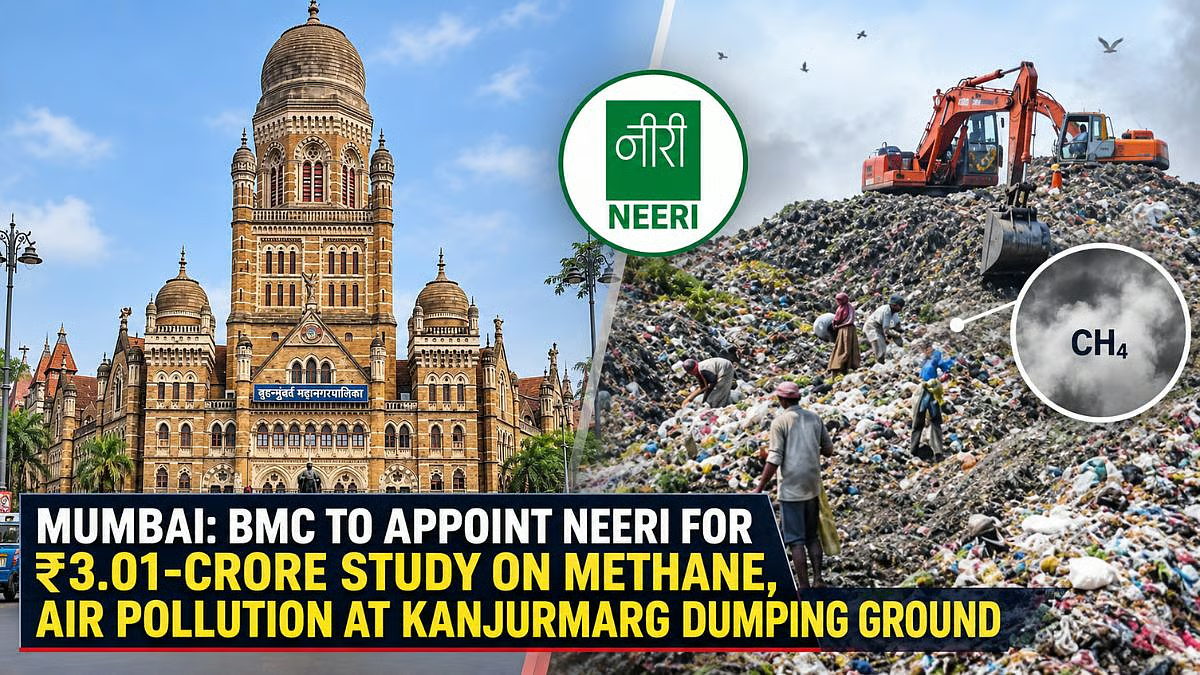
The Rs 3.01-crore assessment follows a Bombay High Court order and will map methane hotspots at the dumping ground over two years.
Kanjurmarg's dumping ground is getting the kind of scrutiny that usually comes only after something's gone badly wrong. In this case, it has. Residents nearby have complained for years about the smell and the fires that keep breaking out, and the Bombay High Court has now told the BMC to stop guessing and start measuring.
The civic body is proposing to bring in NEERI, the National Environmental Engineering Research Institute, for a two-year scientific study on methane emissions and air pollution at the site. The proposal went before the BMC Standing Committee on Wednesday. The price tag: Rs 3.01 crore.
Here's the split. Rs 2.11 crore goes toward quantifying methane emissions using drones, satellite imagery and ground sensors. Another Rs 90 lakh is earmarked for checking air pollution, odour-causing gases and VOC levels in the residential pockets around the facility. Six to 10 monitoring stations are proposed for round-the-clock air-quality tracking, run in consultation with the BMC.
The scale of what's being processed at Kanjur is enormous. Mumbai produces roughly 6,300 metric tonnes of waste every single day, and about 90% of it lands here — 1,000 MT through windrow composting, another 5,300 MT via bioreactor technology. That's a lot of waste to be quietly emitting gas nobody's properly tracked.
The court's attention on this traces back to a PIL, during which the Bombay HC cited a UCLA study and pushed for an independent scientific look at what's actually coming off the mounds. Not just how much pollution exists, but where it's escaping from.
An official quoted on the proposal put it plainly: the point isn't to just collect data for a file somewhere. It's to identify the sources and hotspots of methane and odour, and hand the BMC something it can act on, changes to how the facility is run, where the leaks are, what needs fixing first.
NEERI will use ground sensors, drone surveys, satellite imagery and GIS-based mapping to pin down where methane is escaping across the dumping ground. Progress reports are due at six, 12 and 18 months, with a final report landing at the two-year mark.
And because methane behaves differently depending on the season, the study will run across pre-monsoon, monsoon and post-monsoon stretches, so researchers can actually track how weather shifts change emission levels rather than getting a single snapshot.
For residents who've been breathing this in for years, the timeline is the frustrating part. Two years of study before anything necessarily changes on the ground. The BMC will need the Standing Committee's sign-off first, and then NEERI's clock starts ticking.
What happens if the numbers come back bad, and what the BMC does about the fires that keep flaring up in the meantime, is the question nobody's answered yet.

Be the first to comment
Join the argument. No password, just your email or a passkey.