The American Kennel Club says the blue-black tongue seen in a handful of dog breeds is a harmless genetic quirk, not a sign of illness, and it develops slowly over a puppy's first months.
Spot a dog with a tongue that looks bruised purple instead of pink and the instinct is to panic. Don't, at least not for every breed. According to the American Kennel Club, a small group of dogs are simply built that way, and the blue-black tongue is a genetic trait, not a symptom.
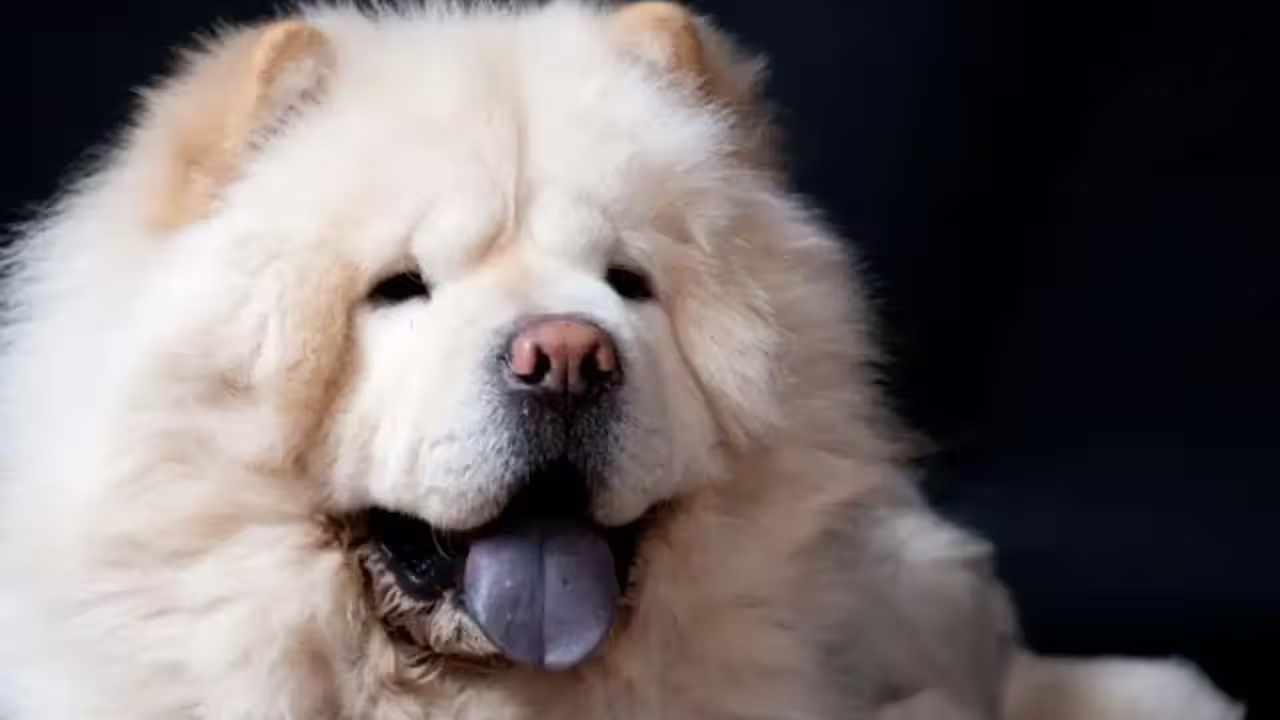
The Chow Chow is the poster child for this. Puppies are born with ordinary pink tongues. The AKC says the shift usually starts between eight and ten weeks, and the tongue keeps darkening for months after that, sometimes taking half a year to fully settle into that signature blue-black. A Chow Chow with a plain pink tongue would actually look a bit off to anyone who knows the breed.
Three other breeds carry the same fully blue or blue-black tongue, per the AKC: the Chinese Shar-Pei, the Eurasier, and the Thai Ridgeback. All of them start pink at birth and darken with age, same as the Chow Chow. It's a short list, which is part of why the trait catches people off guard the first time they see it.
The Shar-Pei's version of the trait is the most talked about after the Chow Chow's, and there's a reason the two get bracketed together. Genetic research points to the Shar-Pei and Chow Chow sharing a common ancestor far back down the line, which likely explains why these two breeds show the pigmentation so consistently while most others don't touch it at all.
What's actually happening under the hood is melanin, the same pigment that decides skin, hair and eye colour, showing up somewhere unusual. Most dogs keep melanin production in the mouth minimal, the standard pink. In Chow Chows and Shar-Peis, a genetic mutation pushes melanin production into overdrive specifically in the mouth and tongue tissue, and that's where the blue-black comes from.
It's not strictly limited to purebreds either. Mixed breeds carrying some Chow Chow or Shar-Pei ancestry, a Chow Chow-Labrador cross for instance, can turn up with partial blue-black patches on an otherwise pink tongue. Little detail, but it can be a giveaway about ancestry that isn't obvious from looks alone.
Here's the distinction that actually matters for dog owners. A naturally pigmented tongue in these breeds has looked that way since puppyhood and stays evenly coloured. Cyanosis, a tongue turning blue or purple from lack of oxygen, is a different animal entirely and a genuine emergency. It shows up suddenly, usually alongside laboured breathing, weakness or pale gums. If a dog's tongue colour changes and you're not sure why, that's not a moment to guess. Get to a vet.
For Chow Chow and Shar-Pei owners, the blue-black tongue is just one more part of the package, alongside the mane and the wrinkles. Small detail, but it's the kind of fact that makes people do a double take the first time someone points it out.




Be the first to comment
Join the argument. No password, just your email or a passkey.