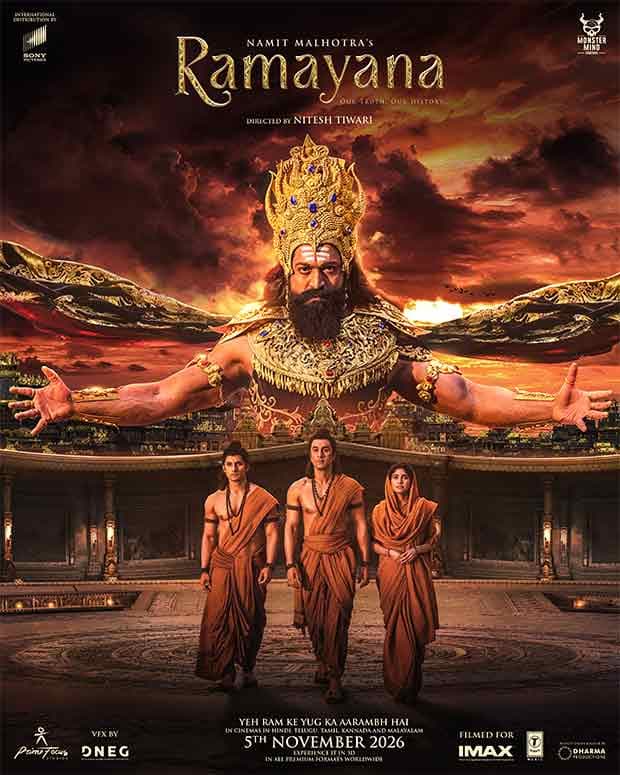
Ramayana: Part I has collected ₹175.94 crore nett in India in its first three days, with 3D formats accounting for ₹115.46 crore—over 65% of total collections. Standard 3D alone contributed ₹98.55 crore, representing 56% of the film's domestic business.
Ramayana: Part I has landed with a roar — ₹175.94 crore nett in India across its first three days, and the numbers tell a story beyond just box office fireworks. Nearly two-thirds of that haul, ₹115.46 crore, came from 3D formats alone. That’s not a footnote. It’s the headline.
Standard 3D screenings accounted for ₹98.55 crore, more than half of the film’s entire domestic business. In percentage terms, that’s 56.01%. The rest? Standard 2D brought in ₹59.96 crore (34.08%), while IMAX 3D added ₹12.54 crore (7.13%).
Smaller premium formats like 4DX 3D, ScreenX 3D, and Dolby Cinema 3D made their mark too, though their individual shares remain modest. What’s striking isn’t just the volume, it’s the value. An IMAX 3D ticket generated an average nett realisation of ₹1,025. That’s over four times what a standard 2D seat earns (₹242) and more than three times the ₹328 from a regular 3D ticket.
IMAX 3D sold just 1.22 lakh tickets, but the revenue per seat is where the real shift lies. Meanwhile, standard 3D drew 30.04 lakh admissions, outpacing standard 2D’s 24.83 lakh. So it’s not just about higher prices. Audiences are choosing 3D in greater numbers.
Bollywood Hungama’s analysis confirms this: the format isn’t a niche add-on anymore. It’s the default. And Ramayana isn’t just a film. It’s proof that when studios bet on premium experiences, audiences respond, with cash, with seats, with attention.
The data doesn’t whisper. It shouts. The future of theatrical release isn’t just about stars or stories. It’s about how you show them.
And right now, that means 3D.

Be the first to comment
Join the argument. No password, just your email or a passkey.